Orthodox Heritage
Saint Thomas the Apostle
Apostle to India, Patron of Our Parish
Life & Legacy
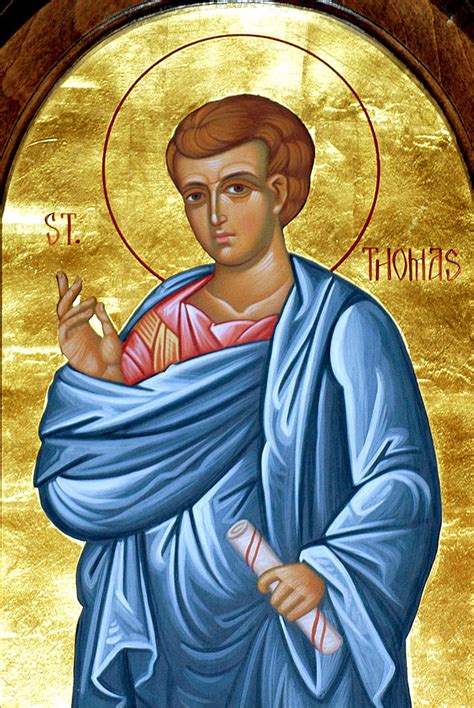
Saint Thomas the Apostle, also called Didymus (meaning "twin"), was one of the Twelve Apostles chosen by our Lord Jesus Christ. Though little is known of his life before meeting Christ, Sacred Scripture and Holy Tradition paint a vivid portrait of a man who progressed from doubt to unshakeable faith, becoming one of Christianity's greatest missionaries.
In the Gospel of John, we see Thomas's earnest devotion and willingness to die with Christ. When Jesus proposed returning to Judea where the Jews had recently tried to stone Him, Thomas said to his fellow disciples, "Let us also go, that we may die with Him" (John 11:16). This reveals a soul ready for martyrdom, willing to follow Christ regardless of the cost.
At the Last Supper, when Christ spoke of going to prepare a place for His disciples, Thomas asked the question that was on everyone's heart: "Lord, we do not know where You are going, and how can we know the way?" (John 14:5). This honest inquiry led to one of Christ's most profound self-revelations: "I am the way, the truth, and the life. No one comes to the Father except through Me" (John 14:6).
But Thomas is best known for what happened after the Resurrection. When the other disciples told him they had seen the risen Lord, Thomas, not having been present, declared: "Unless I see in His hands the print of the nails, and put my finger into the print of the nails, and put my hand into His side, I will not believe" (John 20:25).
Eight days later, Christ appeared again, and this time Thomas was present. The Lord, knowing Thomas's doubts, invited him: "Reach your finger here, and look at My hands; and reach your hand here, and put it into My side. Do not be unbelieving, but believing" (John 20:27).
At this moment, Thomas made the greatest confession of faith in all the Gospels, proclaiming: "My Lord and my God!" (John 20:28). He recognized not only the humanity of the risen Christ but His divinity—the first disciple to explicitly call Jesus "God." Christ responded with a blessing that extends to all who believe without seeing: "Thomas, because you have seen Me, you have believed. Blessed are those who have not seen and yet have believed" (John 20:29).
After Pentecost, according to ancient tradition preserved in the Acts of Thomas and confirmed by Church Fathers like Saint Ephrem the Syrian and Saint Gregory of Nazianzus, Thomas received the lot to preach the Gospel in Parthia, Persia, and India. Tradition holds that his journey to India was providentially arranged.
Thomas preached the Gospel throughout India with great power, establishing numerous Christian communities. He baptized kings and commoners, performed miracles, and ordained bishops and presbyters. The ancient Christian communities of India—the Saint Thomas Christians or Nasrani Christians—trace their origin directly to the Apostle Thomas. Historical evidence attests to early Christian presence in India from the first centuries.
The Apostle met his martyrdom near Madras (now Chennai) around 72 AD, according to tradition. While he was praying before a cross in a cave on the "Big Hill" (now St. Thomas Mount), he was pierced with spears by those who opposed his preaching. His final words were a prayer for his persecutors, following the example of his Lord.
According to tradition, his relics were first enshrined in India, then translated to Edessa (now Urfa, Turkey) in the 4th century. In 1258, they were transferred to Ortona, Italy, where they remain to this day, though some relics are preserved in India and at the Saint Thomas Church in Mosul, Iraq.
Troparion
Let us praise the Apostle Thomas, beloved disciple of Christ our Savior. As we celebrate his holy memory, we pray that he will intercede for us with our God, that He grant remission of our sins and great mercy to our souls. (Tone 2)
Kontakion
Your holy disciple Thomas, O Lord, touched Your side with a trembling hand and cried out with fear and joy: You are my Lord and my God! Wherefore we also cry out: Glory to You, O Christ our God!
Patronal Blessings
As the patronal saint of our parish, Saint Thomas holds special significance for us. His journey from doubt to faith mirrors our own struggles and provides hope that Christ meets us in our questions and transforms our uncertainty into unshakeable conviction.
His words "My Lord and my God" form the foundation of our Orthodox confession—that Jesus Christ is truly God incarnate, risen from the dead, worthy of all worship and glory. Every Divine Liturgy, we receive the same Body and Blood that Thomas was invited to touch, and in that mystical encounter, we too confess with Thomas: "My Lord and my God!"
His missionary zeal reminds us that the Orthodox Faith is not meant to be kept to ourselves but shared with all nations. Just as Thomas brought the light of Christ to India, we are called to be witnesses of the Resurrection here in South Africa.
Our parish honors Saint Thomas the Apostle on the Sunday after Pascha (Thomas Sunday), and again on October 6 (the translation of his relics). On these occasions, we celebrate with liturgy and fellowship, continuing the Serbian tradition while honoring our apostolic patron.
The words "Come and see" (John 1:46), spoken by the Apostle Philip and echoed in Thomas's invitation to encounter the risen Christ, are the motto of our parish. We invite all to come and see the Lord Who is present in the Orthodox Church, in her sacraments, in her worship, and in the lives of her saints—especially our beloved patron, Saint Thomas the Apostle.
Theological & Pastoral Significance
Saint Thomas is one of the most beloved apostles precisely because his humanity is so relatable. His initial doubt comforts us when we struggle with faith. His ultimate confession inspires us when we experience Christ. His martyrdom challenges us to remain faithful unto death. For Orthodox Christians, the Sunday after Pascha—Thomas Sunday (Antipascha)—is a major feast, second only to Pascha itself. On this day, we celebrate Christ's patience with Thomas's doubt and His tender accommodation of human weakness. The Gospel of Thomas (John 20:19-31) is read, and we are reminded that touching the wounds of Christ—which we do mystically in Holy Communion—transforms doubt into faith and death into life. The ancient Christians of India, who claim descent from Thomas's missionary work, have preserved Orthodoxy for nearly 2,000 years, a living testimony to the Apostle's faithfulness and the endurance of the faith he planted.
Authoritative Sources
- ✦The Holy Gospel According to John, Chapters 11, 14, 20-21
- ✦The Acts of Thomas (2nd-3rd century, Syriac tradition)
- ✦Saint Ephrem the Syrian, Commentary on the Diatessaron
- ✦Saint John Chrysostom, Homilies on the Gospel of John
- ✦Eusebius of Caesarea, Ecclesiastical History, Book III
- ✦Orthodox Church in America, Lives of the Saints
- ✦The Synaxarion: The Lives of the Saints of the Orthodox Church (Vol. 2, October)
"Pray for us, Saint Thomas the Apostle, that we may be made worthy of the promises of Christ."
Other Saints of Our Parish
Saint Sava of Serbia
Model of prayer, learning, and humility; shepherd and enlightener of the Serbian people.
Read more →Holy Prince Lazar of Serbia
Witness of faith and sacrifice who chose the heavenly kingdom; inspires steadfastness and hope in Christ.
Read more →Saint Justin Popović
Teacher of prayer and humility; beloved theologian whose writings on the saints illumine the path to Christ.
Read more →